
Media capitulators are not worthy of the Fourth Estate
It’s time to change the way we consume news

I originally wasn’t going to weigh in on Trump’s insane and illegal attack and kidnapping of Nicolás Maduro, the leader of a sovereign state that posed no threat to America. At this point half the authors on Substack have given us their take, so I felt no need to toss in my $0.02.
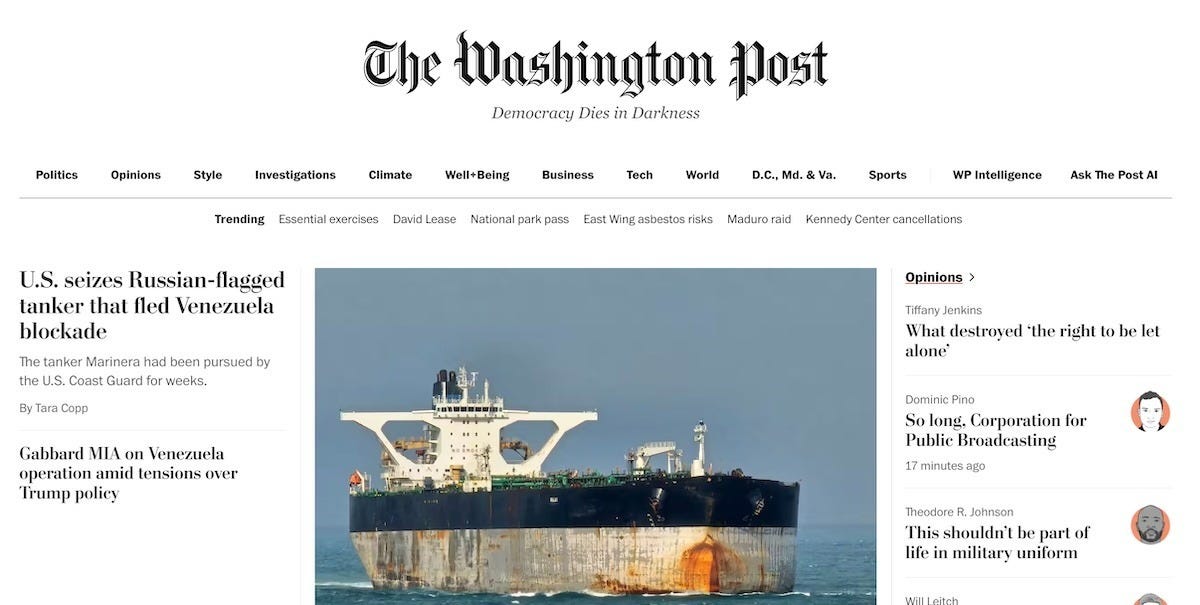
But then I saw this headline for an editorial on the homepage of the Washington Post: “Trump’s bold capture of Maduro was a victory for America. What’s next?”
Here’s the first paragraph:
Millions of people around the world, most of all in Venezuela, are celebrating the downfall of the dictator Nicolás Maduro. President Donald Trump’s decision to capture him on Saturday is one of the boldest moves a president has made in years, and the operation was an unquestionable tactical success. The next step is ensuring that this triumph sets Venezuela up for stability rather than chaos.
The Post brushes aside the fact that Trump’s actions needed authorization from Congress, which didn’t even get a heads up about the attack. They also ignore the international laws and protocols that were broken, and that what occurred in Venezuela establishes the precedent that any nation with the resources to invade a sovereign state and abduct its ruler can do so.
This is the same Washington Post that inspired a whole generation of up-and-coming journalists in the 1970s with their coverage of the Watergate scandal, coverage that would eventually bring down a corrupt presidency. Four years after Watergate broke, I and thousands of young journalists graduated and set out on careers in the news media, filled with the notion that our work would make a difference in our communities and the world.
Fast forward to 2024, and the once-heroic Post makes the decision, in the midst of the most consequential election in anyone’s lifetime, that they will not endorse a candidate for president. Never mind that one of those candidates was convicted on 34 felony counts, had incited an insurrection in a desperate attempt to stay in office and had stolen top secret government documents, compromising national security.
Since then, the Post’s opinion pages, at the behest of billionaire owner Jeff Bezos, have exhibited extreme deference toward Trump, shirking their responsibility as a vaunted member of the Fourth Estate, the unofficial branch of government that holds the other branches accountable. This embarrassing state of affairs has led to the exodus of outstanding journalists at the Post, among them Gene Robinson, Philip Bump, Jonathan Capehart, Ashley Parker, Jennifer Rubin, Ruth Marcus, Ann Telnaes and others.
The demise of the Post points to a big problem in today’s media landscape: Ownership of news outlets by corporate conglomerates creates a conflict of interest when it comes to holding the powerful accountable.
Ironically, Bezos actually saved the Post when he purchased it in 2013. The paper was drowning in debt and needed a massive infusion of cash to turn the ship around, and Bezos provided the resources. The story would have a happy ending if not for an unfortunate turn of events — the comeback of Donald Trump in 2024 leading to his victory that November.
In addition to the Post, Bezos also owns Amazon and the aerospace firm Blue Origin, both of which have government contracts worth billions. Trump made it plain in his campaign that retribution against his perceived enemies would be a central feature of his presidency, and Bezos, not willing to put his holdings at risk, signaled to Trump that he did not wish to be on the enemies list, and he withheld an endorsement of Kamala Harris.
The founders thought the role of the press in safeguarding our democracy was so important that in the First Amendment to the Constitution, they wrote, “Congress shall make no law… abridging the freedom of speech, or of the press.” Thomas Jefferson said, “Our liberty depends on the freedom of the press, and that cannot be limited without being lost.”
Unfortunately, the founders could not foresee nor guard against a situation in which we find ourselves. Corporations that own major media institutions also own businesses that can find themselves at the mercy of an unscrupulous president, and that pressure leads to the kind of self-censoring we saw when CBS pulled a 60 Minutes report on the notorious CECOT prison in El Salvador. The Post’s editorial lionizing of Trump’s misadventures in Venezuela as “one of the boldest moves a president has made in years” makes that once-great paper’s transformation into a propaganda tool for a murderous regime complete. It brings to mind the transition that turned Anakin Skywalker into Darth Vader.
As consumers of news who rely on a functioning Fourth Estate to provide the information and perspective needed to preserve our democracy, what recourse do we have in the face of corporate media owners whose top priority is to preserve their bottom line?
For starters, we have leverage, economic leverage.
When Brendan Carr, the Trump-appointed chairman of the Federal Communications Commissions, suggested that ABC television affiliates might have their broadcast licenses pulled unless late-night host Jimmy Kimmel was taken off the air, Disney/ABC canceled Kimmel’s show. The blowback was instantaneous. People canceled their Disney+ streaming subscriptions and plans to visit Disney theme parks. Disney calculated the economic fallout, and within days reinstated Kimmel.
Following the Post’s decision not to endorse a presidential candidate in 2024, about 300,000 readers canceled their subscriptions. While it was a significant portion of subscribers, the cancellations appeared to have little impact on the Post’s subservient editorial stance. If readers really want to hit Bezos where it hurts, they should stop using Amazon to purchase merchandise.
After CBS spiked the 60 Minutes segment on CECOT, viewers canceled subscriptions to the Paramount+ streaming service. However, Paramount/Skydance, which owns CBS, is run by Trump supporter David Ellison, so it will take a pretty big financial hit for Paramount to reverse course on burying the legacy of Edward R. Murrow. Furthermore, Paramount is attempting a hostile takeover of Warner Bros. Discovery, which owns CNN, a move that would likely remake the cable news network in the image of Fox News.
While consumers have scored some victories in skirmishes with media giants that capitulate to Trump, the jury is still out on whether that economic leverage will be enough to make corporate owners stop groveling at Trump’s feet.
The other option we have is choice.
Alternatives to corporate media have existed since the dawn of newspapers, but the launch of the World Wide Web in the early 1990s made such alternatives more widely available to the general public. Sites like The Intercept, ProPublica, Alternet and Mother Jones now report and disseminate news in a not-for-profit model where the only obligation is to the readers.
Our options for corporate media alternatives rose dramatically in 2017 with the creation of Substack, the self-publishing platform that enables authors to build an audience and generate income. The platform exploded during the pandemic as media companies laid off reporters and editors, sending many talented writers looking for a way to ply their trade and pay bills. While there are similar platforms out there, such as Patreon and Ghost, Substack currently dominates the digital-publishing space, with 63,000 newsletters published on the platform.
If you subscribe to this newsletter, Problem Solved, you know about Substack. What you may not know is the tremendous breadth and depth of content the platform offers, all of it supported by subscribers who don’t have to wonder whether stories are being withheld to appease corporate overlords. This abundant content allows readers to curate a list of authors to keep them well-informed on current events. Want news and perspective that touches on the economy? Subscribe to Nobel Prize-winning author and former New York Times columnist Paul Krugman. Want historical insight on the news of the day? Subscribe to Heather Cox Richardson’s Letters from an American.
The drawback is that in order to get a complete picture of the day’s news, as you would find on the homepage of New York Times, you might have to subscribe to a dozen or more Substacks. If that’s the approach you want to take, I’d start with the list of top U.S. politics Substacks and subscribe to the ones that match your interests. When you get to the bottom of the page, you’ll find a list of topics — technology, business, sports, environment, science, etc. — to explore additional Substacks that appeal to you.
Given the variety and quality of news-related content available on Substack, it would seem the platform could create a news site — The Daily News on Substack? — that links to the day’s best newsworthy posts and looks much like other major news sites. A few years back, such an endeavor would require an inordinate investment in staff to sift through thousands of posts each day and find the best articles and commentary to link to. With an assist from AI, however, the task could be accomplished with a modest outlay in resources. It would be a win for the platform and a win for authors who would get more exposure.
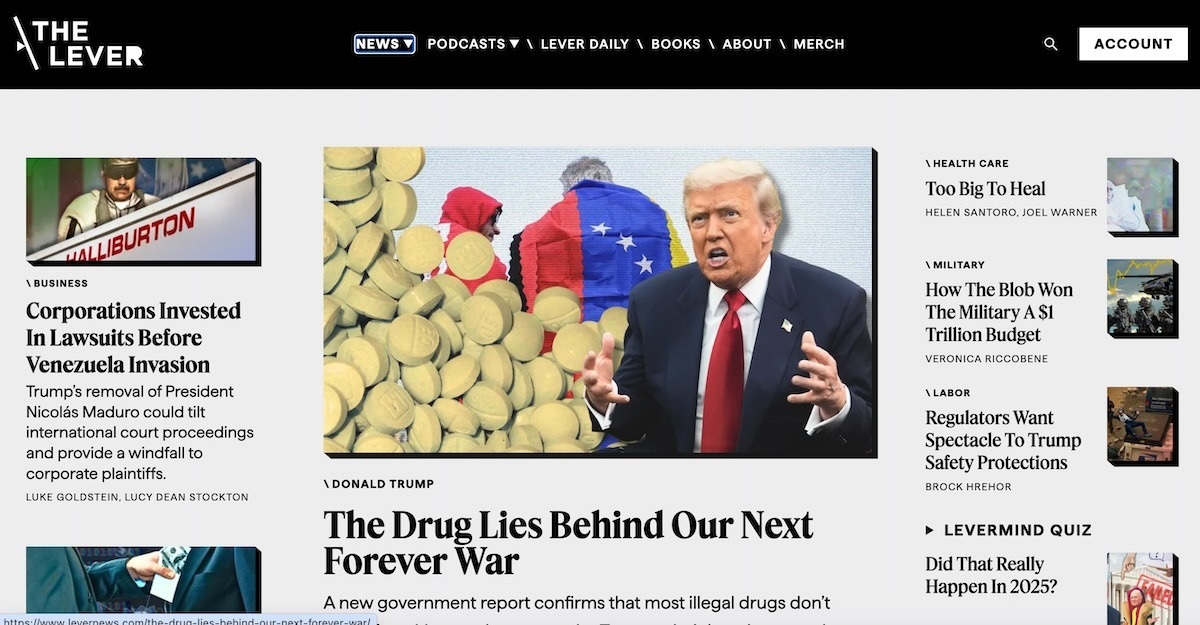
Most Substacks are solo enterprises, but there are some where a team of writers band together to offer more diverse content. One such site is The Lever, founded by author David Sirota, which started on Substack and moved to Ghost’s platform a few years back. The site offers investigative news “that holds accountable the people and corporations manipulating the levers of power.” I highly recommend it.
We live now in a media landscape where major news outlets are owned by multi-corporate entities whose loyalties lie not with the First Amendment and the search for truth, but with doing whatever must be done to preserve profit margins. The big exception is the New York Times, which has been controlled by the Ochs-Sulzberger family since the late 19th century. While the Times is not perfect — they sane-washed Trump during the 2024 presidential campaign — they pull no punches out of fear that pissing off the wrong people will affect them financially.
In short, do the research to find out who owns and controls the news outlets you rely on. If there’s a conflict of interests that prevents them from protecting the public interest, drop them and search out sources that are reader- and foundation-funded that don’t prioritize a return on shareholder investment.
Good piece Steve! Yep… the only problem with a capitalist society is the capitalism. The greedy capitalist always wants more, and then they want power and control… and here we are. Keep up the good fight!!
Magnificent work, Steve. Keep at it!