
From climate problem to climate solution
We need to change the way we grow food

One of the catastrophic problems of climate change is that it diminishes our ability to grow food — prolonged droughts, devastating heat, crop-destroying floods and unpredictable weather patterns.
Based on a study published last year in Nature, the Stanford School of Sustainability reports that at the current rate, climate change will reduce the yield of staple crops — wheat, corn, soybeans, barley, and cassava — by 24 percent by the end of the century. The exception to staples is rice, which benefits from higher nighttime temperatures. But the lower supply of most staples, combined with higher demand — there continues to be more mouths to feed — means we will pay more for the food we eat.
But agriculture is not just a casualty of climate change. It’s also a cause. It’s estimated that the processes of growing food contribute roughly one third of the greenhouse gas emissions that are heating up our world. Agriculture produces three types of greenhouse gases:
Carbon dioxide: Plants soak up CO2 as they grow. As they die and decay, some of that CO2 is released back into the atmosphere, but much of that plant matter returns to the soil where that CO2 is stored. In modern agriculture, however, tilling of the soil releases that CO2 from the ground.
Nitrous oxide: A very powerful greenhouse gas, nitrous oxide forms when nitrogen used in fertilizer combines with oxygen in the air. Our farming methods have depleted most of the nutrients that are naturally found in the soil, forcing farmers to rely more and more on nitrogen fertilizers.
Methane: Another powerful greenhouse gas, methane is released by livestock in the digestive process — when they burp and poop. Many large animal farms store animal waste in ponds that release large amounts of methane.
Forests sequester about 30 percent of the carbon dioxide emitted from burning fossil fuels, but as more land is needed to grow food for an ever-increasing population, forests are being cleared for agriculture. Because of the heat and drought caused by climate change, wildfires are becoming more frequent and destructive, further reducing carbon-storing forests and releasing more CO2.
But what if, by changing the way we grow food, we could turn farming from a climate problem into a climate solution? While it won’t solve all the climate problems associated with farming, the approach known as regenerative agriculture takes a step in the right direction.
In short, regenerative agriculture is all about restoring and maintaining healthy soil by using no-till farming, cover crops and managed grazing. This trailer for the documentary “Roots so Deep” provides a quick overview:
Let’s start with no-till farming. In standard farming practices, soil is tilled — dug up — to prepare for planting. The tilling, however, breaks up organic matter in the soil, releasing carbon dioxide that was being stored in the ground. With no-till farming, seeds are planted on undisturbed soil, preserving organic matter that provides nutrient-rich soil for crops. These healthier soils allow more rainwater to be absorbed in the ground, preventing soil erosion and providing moisture for plants during times of drought. By not tilling the soil, carbon sequestered in the ground stays in the ground.
Cover crops work in tandem with no-till farming to rebuild and preserve healthy soil. In the off-season, when cash crops are not growing, cover crops — usually some type of grass — are planted to prevent soil erosion and nutrient runoff. These cover crops also sequester carbon and help soils absorb excess rainfall.
The third tool in regenerative agriculture, managed grazing, is the most interesting. It mimics the behavior of herding animals like bison that have been around since before humans started growing food. In managed grazing, a tract of land is divided into a number of parcels, and the animals are moved from one parcel to the next in order to avoid over-grazing of forage and over-trampling, which destroys the root systems of the plants. As they graze in each parcel, the animals fertilize the soil with their waste.
Together, these three practices produce healthier, richer soils that remove carbon from the air rather than emitting it. These nutrient-rich soils also don’t need nitrogen fertilizers to be productive, reducing the amount of nitrous oxide — that very potent greenhouse gas — that is heating up the planet.
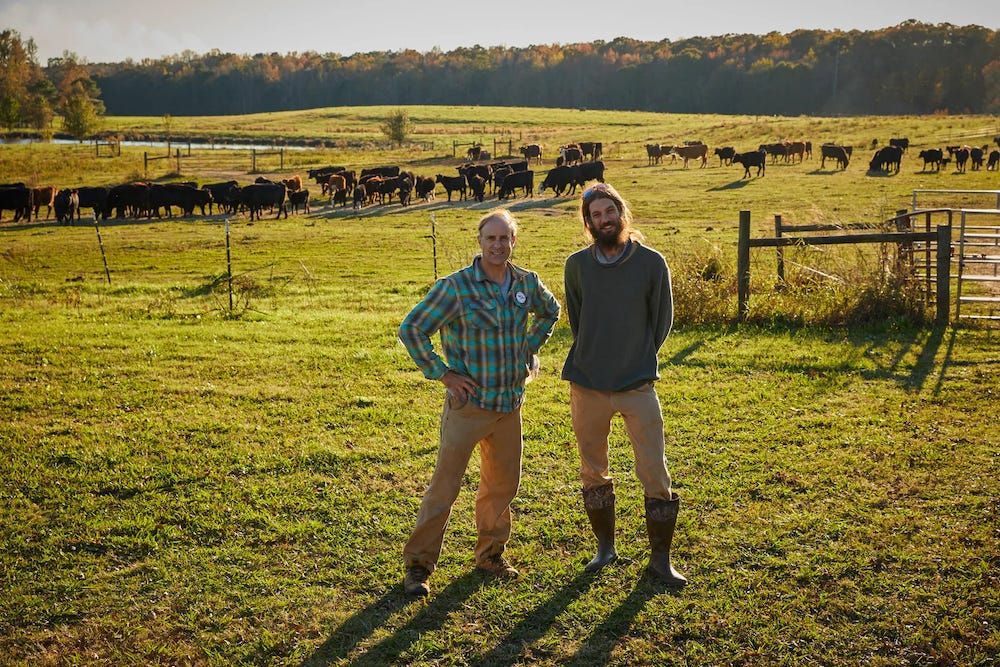
“No good regenerative agriculture grazer is using added nitrogen fertilizer,” said Alan Jenkins. “If it was good enough for bison, it’s good enough for regen ag grazers. That’s the philosophy, to work as ecosystems worked for millennia.”
I met Alan years ago when I started the Atlanta chapter of Citizens’ Climate Lobby. He took over his family’s farm in Rutledge, Georgia, a couple of years ago and started practicing regenerative agriculture. He sells meat products through his business, Academy Mill Farm, and expects the enterprise to be profitable within a year or so. And the grass-fed cattle and sheep have more nutrient dense meat, with more Omega 3 fatty acids (healthy) rather than Omega 6 fatty acids (not healthy) found in grain-fed animals.
One of the negative impacts of climate change is more frequent and severe droughts, which reduce crop yields. The richer, healthier soil resulting from regenerative agriculture, though, increases the ground’s ability to absorb and retain water, helping farmers to adapt to our changing climate.
“I’m building up soil and grasses that will build more insect populations and creating a climate resilient model of agriculture, where soil resists drought and recharges groundwater and protects streams,” said Alan.
Although only 1.5 percent of farmland is being cultivated with regenerative agriculture, momentum appears to be shifting toward this promising method, and studies find the practice increases net farm income by an average of $65 an acre. One farmer in California reported a net increase of $425.19 per acre. Check out this interview with him below.
This year, the U.S. Dept. of Agriculture launched the Regenerative Pilot Program, which will provide $700 million to help farmers who want to use regenerative practices. This all sounds good, but it would have been a lot better if the Trump administration hadn’t slashed the $2 billion authorized by the Biden administration for climate-smart agriculture. In other parts of the world, the Savory Foundation is providing funding for regenerative agricultural projects that cover millions of acres of farmland.
In Congress this month, Sen. Jeff Merkley (D-OR) and several colleagues reintroduced the Soil Conservation And Regeneration Education (Soil CARE) Act, which would educate and train farmers in the regenerative techniques that produce healthy soils. “As climate chaos continues to make the West hotter and drier, we must ensure our farmers, ranchers, and land stewards have the resources and tools they need to keep their lands adaptable and resilient, leading to healthy and regenerative soils,” said Merkley.
Regenerative agriculture is not the panacea that will fix all the climate problems related to farming, but it could make a dent in tamping down emissions and help farmers adapt to a more inhospitable climate. I’ll look closer at legislation that might be in the works to scale up this solution in a future post.
Thanks, Steve. I look fwd to reading others' comments.
I'm skeptical of putting polite titles on grazing cattle or sheep which are both ruminants. These are the animals that have a rumen to pre-digest grasses. These are the animals responsible for significant methane (CH4) emissions from the bacteria burped up from the microbial action in their rumen. I suggest a better approach to meat is simply to stop eating all beef and lamb. Simply swapping out all of the beef in a typical American diet for fish, chicken, pork causes a larger CO2e emissions reduction than the remaining switch to a vegetarian diet. I feel like the arguments that any currently adopted practice for raising all the beef eaten in the US is greenwashing or misguided at best.