
Do we really need all these data centers?
As opposition grows, some see an AI bubble that is destined to burst

People are not embracing artificial intelligence with the kind of enthusiasm that greeted previous technological breakthroughs, like personal computers and the World Wide Web. Maybe it’s because for the first time we have a new technology that appears likely to eliminate more jobs than it will create. Maybe it’s the lack of trust we have in the billionaire tech overlords who control and deploy this technology.
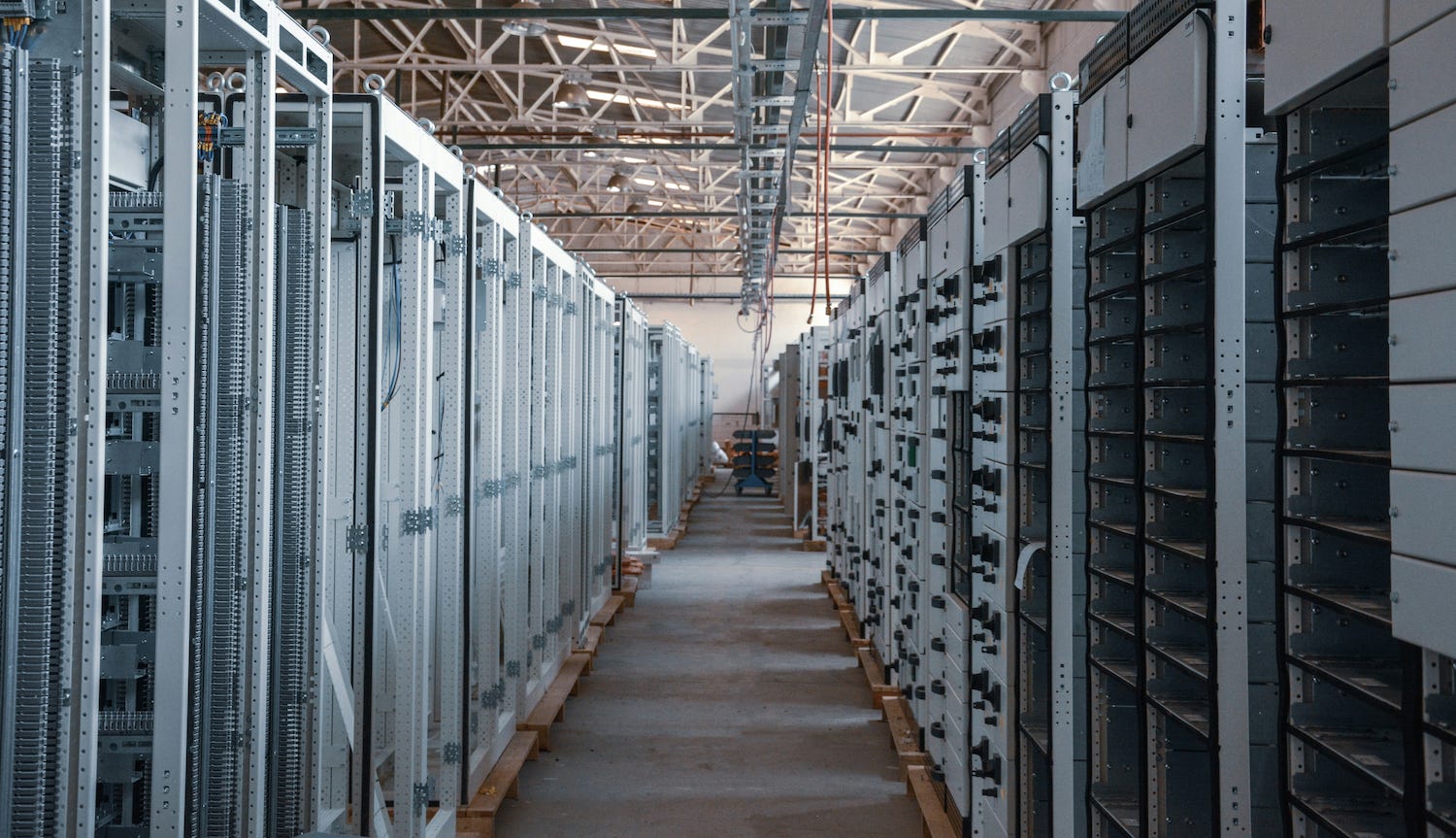
But perhaps the biggest reason AI is getting the cold shoulder is the insane amount of infrastructure being built across the country to support this technology, data centers that are straining the electricity and water resources of local communities. As demand for electricity to power these facilities goes up, utilities plan to build more power plants and upgrade their power lines and grids to meet that demand. The cost of that infrastructure is paid by residential consumers in the form of higher electric bills.
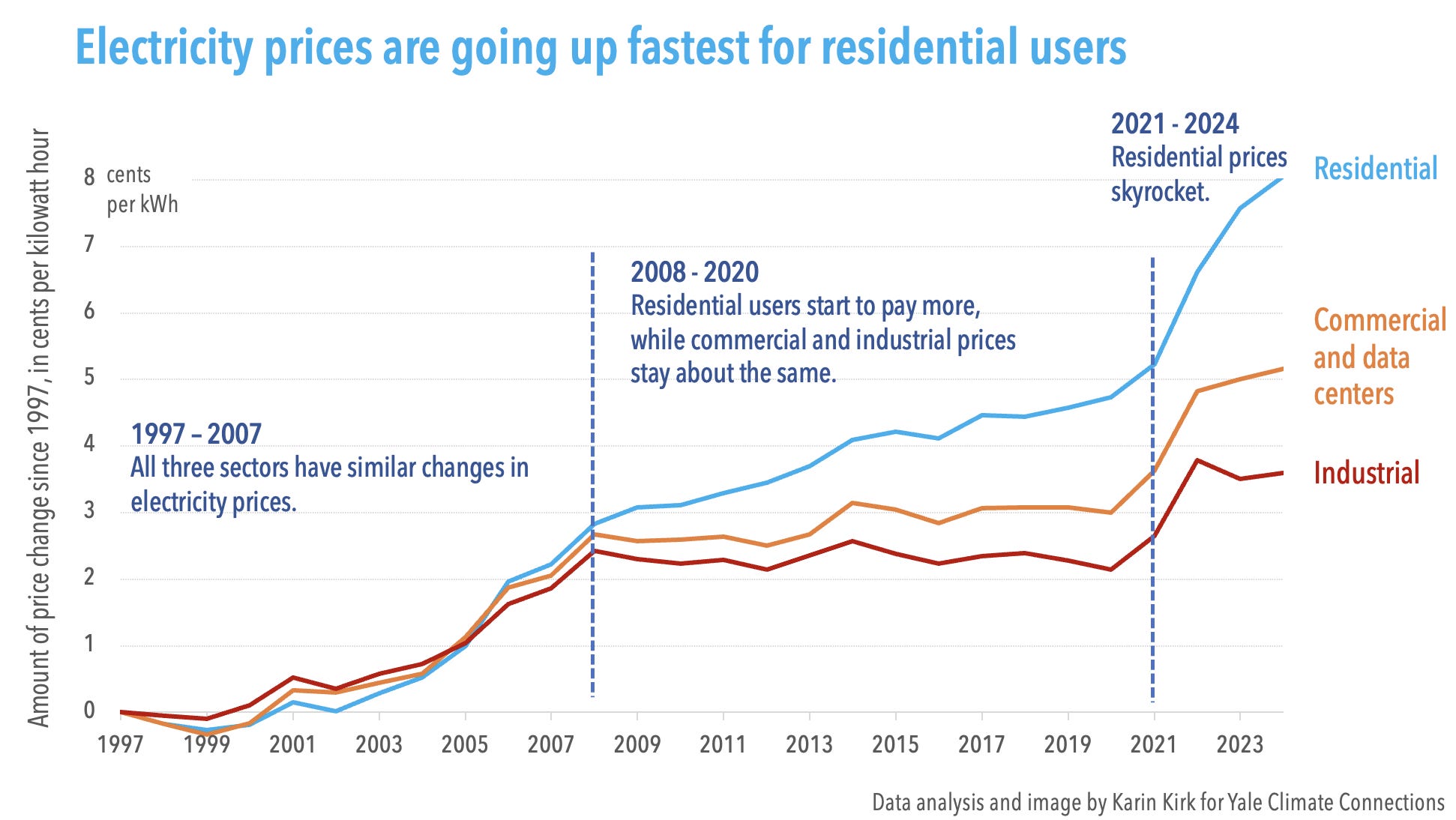
Yale Climate Connections reports how consumers are basically subsidizing the cost of power used for these data centers:
In just two years, starting in 2022, residential electricity prices rose by 10%, while commercial prices increased by only 3%, and industrial electricity prices fell by 2%... [A]t the root of it all, the data suggests that everyday people are footing the bill while companies that consume ever more power are paying less. At a time when corporations seem to enjoy many structural advantages over consumers, from lower tax rates to relaxed pollution requirements, the burden of rising energy bills can make one feel powerless. And yes, the pun was intentional.
Alarmingly, much of the electricity being added for these data centers will be generated by fossil fuels, the burning of which is the primary culprit behind global warming. Remember climate change, that little problem making large swaths of the earth uninhabitable? Scientists have warned for more than a generation that we face catastrophic consequences if we don’t transition away from the use of fossil fuels. The AI gold rush, however, throws caution to the wind where climate change is concerned. Let’s see… a livable planet or amusing videos of dancing cats? Which do we need more?
As Inside Climate News reported last December, Georgia’s Public Service Commission gave the green light for Georgia Power to proceed with plans to add 10 gigawatts of electricity to the state’s power grid, with 60 percent of the power being generated from natural gas. Georgia Power claims the additional power is needed to meet energy demands for data centers that are sprouting up throughout the Peach State.
“The approval is going to set us even further back on making climate progress,” said Jennifer Whitfield, a senior attorney with the Southern Environmental Law Center. “It’s really frustrating, because we were making incremental progress as a state.”
In late January, the Georgia Environmental Protection Division approved permits for the gas-powered facilities. The Southern Environmental Law Center and Sierra Club are now challenging that approval.
In case you’re wondering why Georgia Power is pushing gas-fired power plants instead of incentivizing rooftop solar, the reason is fairly simple: Georgia Power makes more profit by building new plants. The Georgia Public Service Commission guarantees a return on equity (RoE) of 10 percent to 12 percent on capital investments, allowing the company to raise rates to get their RoE. Since there’s no money to be made in having their customers feed solar energy into the grid, turn on the gas, baby!
As the ramifications of these data centers become more apparent — higher electric bills, dwindling water resources, impact on climate change — more and more people are telling developers and local governments they don’t want them in their communities. The New York Times reports that last year 48 projects totalling $156 billion in investment were blocked or stalled by local opposition. Even so, analysts predict that AI “superscalers” will spend $710 billion on data centers in North America this year.
Erin Brockovich, an environmental activist portrayed by Julia Roberts in a 2000 film, has launched a website to track AI data centers across the country: “The RACE to build AI infrastructures is unfolding town by town across America. In some places, data centers are welcomed. In others, they are delayed, contested or abandoned altogether. This MAP captures the real-world footprint of that race — revealing patterns of growth, conflict and uncertainty.”
Given the concerns about data centers, what is the best path forward?
At the very least, the following guidelines should be put in place:
The cost of additional electricity needed for data centers should be borne by developers, either by generating their own power or paying a development fee to utilities that need to increase their generating capacity to serve those needs. Costs should not be passed on to residential customers in the form of rate increases.
Additional capacity, whether generated by the data centers or the local utility, must eschew the use of fossil fuels and rely on sources like solar, wind, batteries and hydro-power. To preserve a livable climate, we simply cannot build infrastructure that will add more heat-trapping emissions to our atmosphere. Such facilities have a lifespan of 30 to 40 years, long past the time when we should phase out fossil fuels.
Developers must ensure that adequate water resources, needed to cool data centers, are in place and that their excessive water use does not create shortages for local residents.
Steps must be taken to reduce noise from data centers — mostly from cooling systems — that could cause stress and lack of sleep for residents.
The process for approving data centers must be open and transparent, allowing local residents the opportunity to voice concerns and ensure that developers are addressing those concerns.
But the bigger question is this: What if we don’t need to build so many data centers?
The big tech companies developing AI scoff at such a question. The investment, they say, needed for data centers between now and 2030 is projected to be nearly $7 trillion (yes, trillion with a “t”). Global data center capacity is expected to double by the end of the decade.
Some observers, however, are not so bullish. They see an AI bubble similar to the dot-com bubble of the ‘90s and the housing bubble of 2008. In a conversation with historian Heather Cox Richardson, Nobel Award-winning economist Paul Krugman explained what a bubble is:
“[A] bubble more or less means that people are investing in something that has no realistic chance of paying off—not socially but just commercially, to an extent that justifies the amount of money being thrown at it. Crucially, a bubble is something that people do because everyone else is doing it. So, Robert Shiller, the great bubble theorist of modern economics, said that a bubble is a natural Ponzi scheme. It’s something where you get in and you make money because other people get in, and people keep on coming in because everybody before them made money. But in the end, it’s a game where the money isn’t really there. It all depends on fresh crops of suckers coming in. And at some point you run out of suckers.”
For the moment, there appears to be an inexhaustible supply of suckers willing to throw money at AI despite the fact that the numbers don’t add up. Writing in TIME magazine in March, Ganesh Sitaraman and Asad Ramzanali said, “There is a fundamental mismatch between the trillions being invested in the infrastructure to develop AI and the billions people and companies are spending to use AI… Unless AI revenues grow by orders of magnitude soon, there’s a Grand Canyon-sized gap that will be hard to cross.”
Former Secretary of Labor Robert Reich breaks it down: “As more and more investors borrow piles of cash to get in on the action, the bubble grows. But when it becomes evident that way too much has been invested relative to the potential for profits, the bubble bursts.”
Last December, a report for Southern Environmental Law Center — “Impacts of Projected Data Center Growth and Emerging Uncertainties on Power Demand in the Southeast,” — looked at the plans utilities in Georgia, Alabama, North Carolina and South Carolina have for the growth of electricity demand related to data centers. It found those plans have grossly overestimated the need, saying the growth of demand they planned for has a 0.2 percent chance of actually happening.
In other words, all those gas-fired power plants they want to build probably won’t be needed. Nevertheless, as I mentioned earlier, the Georgia Public Service Commission approved Georgia Power’s request to add 10 gigawatts of power, mostly to meet the needs of data centers. “This decision goes against expert claims and the recent testimony of the PSC’s own staff stating that five Hoover Dams’ worth of energy is unnecessary,” said Amy Sharma, executive director of Science for Georgia. “The approved plan will cost customers an estimated $50-60 billion over the life of the resources.”
So, before we throw up data centers and CO2-spewing power plants willy-nilly across the land, perhaps we should take a beat to see if the AI boom is going to pan out the way investors hope it will. If a bubble is indeed about to burst, we can limit the fallout by applying the brakes now.
There’s no doubt that AI holds great potential, particularly in the field of medical research, but let’s approach its development in a level-headed manner that protects communities and preserves a livable world for everyone.
Kudos, Steve. There are SO many questions about this data center buildout.
One that I brought up in a recent note is this: what is all this new AI supposed to be for?
We already have AI being heavily used in science, which is appropriate. We already have the AI apps that ordinary people can use to draw pictures and make music and videos. Search engines have AI summaries that can be helpful to writers.
Yes, we already have all this stuff, and presumably we already have the data management capacity to do the things we already do.
SO why do we need vastly MORE of it?
I cannot believe that it's just to satisfy growing demand for the things I've listed above.
There are those who have suggested a reason far more ominous and disturbing: to be able to collect the most intimate details about every human being in the developed world, for surveillance and control.
Ponder that for a moment.